A question worth sitting with
- Messenger
- Telegram
- Snapchat
What do all of these have in common?
The service isn't as free as it looks. You are the payment.
Not in cash. In the record of who you know, who you talk to, how often, from where, and at what hour — which over a few years is worth considerably more than a subscription would have been. None of what follows is a secret or an accusation. It is what their own published privacy policies describe.
You gave away your family's details, and you were the one who promised it was allowed
The app asked you for your address book, and you said yes. The numbers in it belong to your family, your colleagues, your patients, your clients — people who were never asked, never consented, and in many cases do not use the app at all. Your permission was accepted in place of theirs.
It goes further than most people realise. WhatsApp's own Terms of Service have said for years that you provide the phone numbers in your address book and that you “confirm you are authorized to provide us such numbers”.1 Read that again. You did not merely hand over other people's contact details — you gave a formal assurance that you had their permission to do it. Almost nobody has ever asked. If that information is later misused, the company has already had you certify the sharing was authorised.
And you cannot hand over only the phone numbers
When your phone asks “Allow access to your Contacts?”, there is one answer and it is all of it. That permission covers every field of every record: birthdays, anniversaries, home addresses, the relationship labels you set — mother, spouse, child — and whatever you have ever typed into a notes field. Door codes. Alarm codes. Account numbers. The passport number you saved for a booking. The social security number you put beside an elderly parent's entry to help with their paperwork.
There is no setting that grants less. What an app then takes from that pile is governed by nothing but its own policy — which it writes, and can revise. In 2013 the social network Path was found to be uploading users' address books in their entirety; it paid the FTC $800,000 and accepted twenty years of independent privacy audits.2 That is what an all-or-nothing permission means once someone decides to use it fully.
To be exact, because it matters: the major messengers say they take phone numbers, not your notes field,3 and WhatsApp now encrypts contact names on your device before storing them.4 The problem is not that they are all secretly reading your mother's date of birth. It is that the door you opened has no lock on it, the promise that they will only take a little is theirs to revoke, and the people on the other side of it were never told the door existed.
The people affected cannot even object
They have no account, no relationship with the company, and no way to know it happened. They cannot request deletion of something they were never told was collected. A company they have never heard of holds a map of who they know — assembled from thousands of address books like yours.
The envelope, not the letter
“We kill people based on metadata.”
General Michael Hayden, former Director of the NSA and of the CIA, Johns Hopkins University, 20148
Several of these apps genuinely encrypt what you write, and we are not going to pretend otherwise. But the metadata — your phone number, your device, your IP address and so roughly where you are, who you message, how often, when, and which groups you belong to — is collected, and in Meta's case is shared across its other products. Who you talk to at 2am, and how the pattern changes, says a great deal without a single word being read.
Your phone number is the key that joins everything
Because your number is your identity on these services, it becomes the join key that links your messaging to every other record keyed to that number: data brokers, loyalty schemes, old breaches, advertising profiles. In 2021 the details of roughly 533 million Facebook users — names, phone numbers, locations, dates of birth and email addresses — were published free on a criminal forum. Ireland's Data Protection Commission fined Meta €265 million over it, and the inquiry was into the Messenger and Instagram contact importer tools — the very feature described above.5 Numbers do not rotate, and neither does your mother's date of birth. That one is permanent.
And when a warrant is inconvenient, the data can simply be bought
Most people assume the police need a court order to track where they have been. Since 2018 that has been true when the government compels a phone company to hand it over. It is not true when they buy it.
Thousands of ordinary apps — weather, games, shopping, prayer apps — carry advertising kits that quietly report location. Brokers buy that telemetry, merge it, and sell it on. Government agencies are among the customers, and the argument for needing no warrant is simply that a purchase is not a search. That is not speculation: America's own intelligence community said so in a report it later declassified, which found agencies narrowly reading the Supreme Court's ruling so as to keep purchasing protected information, and acknowledged they could persistently track millions of Americans without a warrant so long as they paid for it.6
Nor is “anonymised” any protection. A location trail is a fingerprint: the place you sleep and the place you work identify you by themselves, and everywhere else you go attaches to that name. In 2024 the FTC brought its first cases banning brokers from selling sensitive location data — trails that revealed visits to clinics, places of worship and addiction treatment.7
None of this requires anybody to have done anything wrong, and none of it requires you to be told. The market exists because apps carry advertising kits that collect. To be precise, this is not a charge against the messengers named above — they are not selling your location to brokers. It is the water the whole app economy swims in, and most people have no idea it is happening.
Channel carries no advertising kits, no analytics and no third-party code of any kind. There is no telemetry to aggregate, so there is nothing to buy — with or without a warrant.
Stored messages are a liability that outlives the conversation
Where messages or backups sit on a company's servers, they can be subpoenaed in a lawsuit or a divorce, produced in discovery, seized, or exposed in a breach. Combine a leaked number with a name and a few relationships and you have the raw material for phishing, SIM-swap fraud and password resets. A conversation you had years ago becomes a risk you cannot retire.
Not every messenger does this, and it would be dishonest to imply otherwise. Signal is a donation-funded nonprofit that does not monetize its users, and it is not on the list above for that reason. We would rather you trusted this page than won an argument with it.
Why it matters
Privacy Matters!
Not because you have something to hide. Because a record of who you talk to is a record of who you are — your doctor, your lawyer, your union rep, the job you applied for, the person you left, the diagnosis you have not told anyone about yet.
You cannot un-share it. Data is copied, merged, sold onward, retained after the company that took it is gone, and exposed by a breach at a firm you never chose to deal with. A policy that protects you today can be rewritten in an email you will not read.
The only information that cannot be leaked, subpoenaed, sold or breached is the information that was never collected. That is the whole design.
How it compares
Honestly, including where we lose. A table that only flattered us would tell you nothing, and you would be right not to believe the rest of the page.
| Channel | Signal | Telegram | ||
|---|---|---|---|---|
| Works with no internet and no signal, when your contact is nearby | ✓ | — | — | — |
| No phone number needed | ✓ | — | — | — |
| No account to create | ✓ | — | — | — |
| Never sends your address book anywhere | ✓ | — | ~ | — |
| End-to-end encrypted by default | ✓ | ✓ | ✓ | — |
| No advertising identifiers or third-party tracking code | ✓ | — | ✓ | — |
| Group chats | — | ✓ | ✓ | ✓ |
| Voice and video calls | — | ✓ | ✓ | ✓ |
| Desktop app | planned | ✓ | ✓ | ✓ |
| People you know are already on it | — | ✓ | ✓ | ✓ |
| Free | — | ✓ | ✓ | ✓ |
- Signal checks which of your contacts use Signal by sending scrambled forms of the numbers into sealed hardware, rather than uploading the book itself. Better than the others by a distance, but not nothing.
- Telegram encrypts ordinary chats between you and its servers, not end to end. Only its separate “Secret Chats” are end-to-end encrypted, and they are not the default.
- Channel will be paid. The others are free because you are the payment — which is the argument this whole page makes, and it is fair to hold us to the other side of it.
Read the bottom four rows again. We have no group chats, no calls, no desktop app yet, and almost nobody on it. Those are real reasons to keep using what you have, and we would rather you heard them from us. What the top of the table buys you is a conversation that never touches a company at all — and that is the only row we think is worth switching for.
What Channel does instead
- No account. Nothing to sign up for, nothing to sign in to.
- No phone number and no email address, at any point.
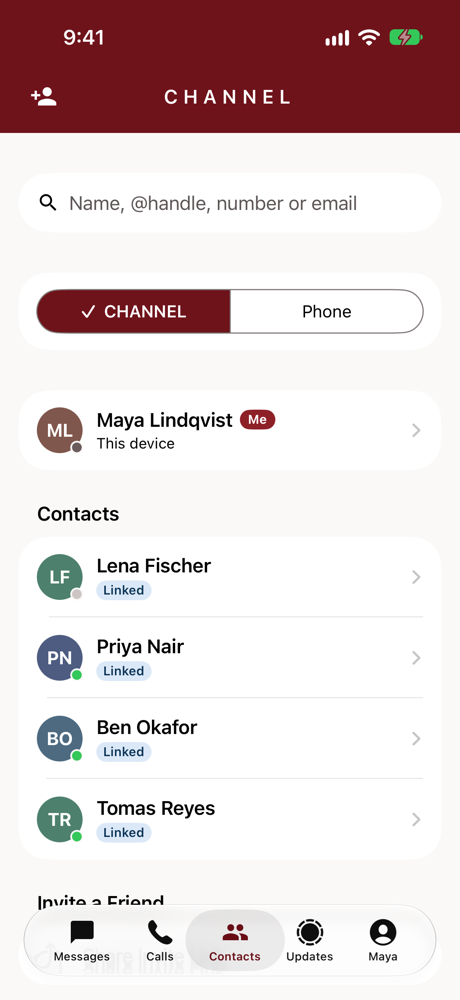
- No contact upload, ever. The app can show you your own address book so you can pick a name; that list never leaves your phone.
- No analytics, no advertising identifiers, no third-party SDKs.
- No message history on any server once delivery is confirmed.
- When your contact is in range, no internet connection at all — so no bill, no roaming, and nothing to intercept upstream.
Messaging in range
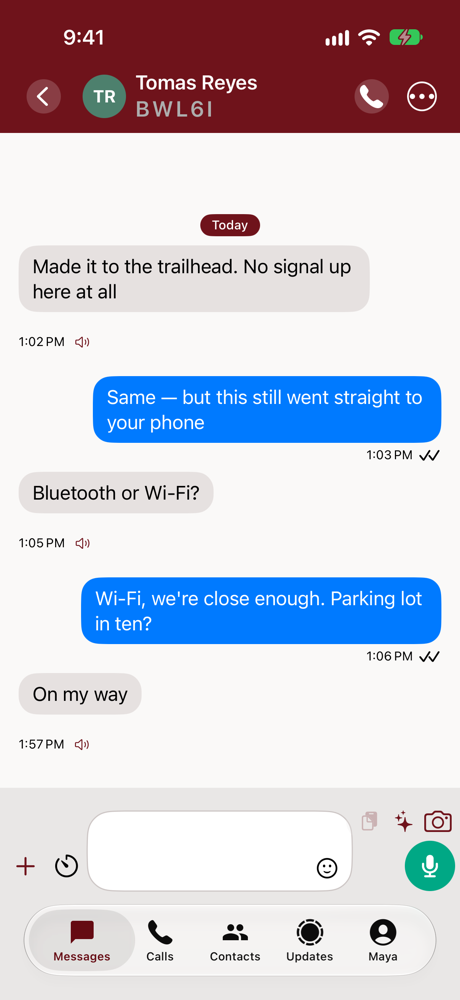
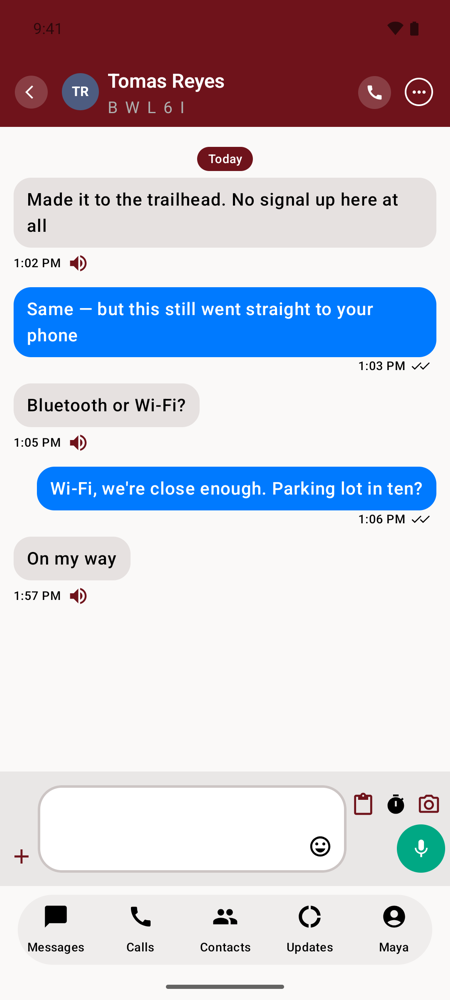
When you and a contact are within Bluetooth or Wi-Fi range, your message goes device to device. There is nothing to intercept in transit because nothing is in transit anywhere else, and it works with no signal and no data plan. If your phone is in your pocket when a message arrives this way, the app wakes on the connection and creates the notification itself.
It also works where the network is congested rather than absent, which is the case most people actually meet. A cell tower is built for the people who live, work and drive through its patch. It is not built for a whole city's worth of extra people standing in a quarter of a square mile for five hours, most of them sending photographs and video of the same touchdown. Your phone shows four bars and will not send a text — because signal strength and capacity are different things, and the bars only ever showed you the first one. Channel does not queue behind that crowd, because it never asks the tower for anything.
Be realistic about distance, though. This is a radio link between two handsets: your group a few rows apart, the concourse, the tailgate, the next room, the same carriage, a boat, a basement. It will not carry from the club level to the cheap seats, and it does not extend your range beyond direct radio contact. A crowd is the hardest case for a small antenna — bodies absorb these frequencies, which is precisely why the tower is struggling too.
Out of range
Most conversations are not conducted standing next to each other. When direct radio is not available, your message can be queued and, if you allow it, carried by our server over the internet instead.
That server is not a chat service. It cannot read your messages — they stay end-to-end encrypted the whole way, and it never holds the keys. It does not know who you are: no accounts, no phone numbers, no email addresses. It identifies your inbox only by a token that changes every ten minutes, and it is configured not to log the IP addresses that connect to it. A message is deleted the moment it is confirmed received, and anything nobody collects expires on its own — thirty days at the outside, and you can set it shorter.
We are telling you plainly that this path exists, and that your message does transit a server when you use it. A messenger that only worked standing next to your contact would not be very useful, and we would rather say exactly what the fallback is than let you assume it is something it is not.
Nothing new to learn
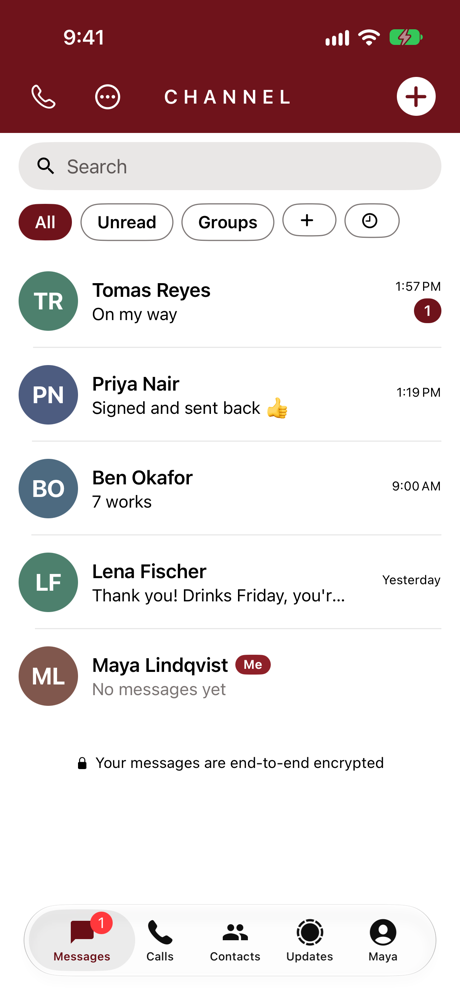
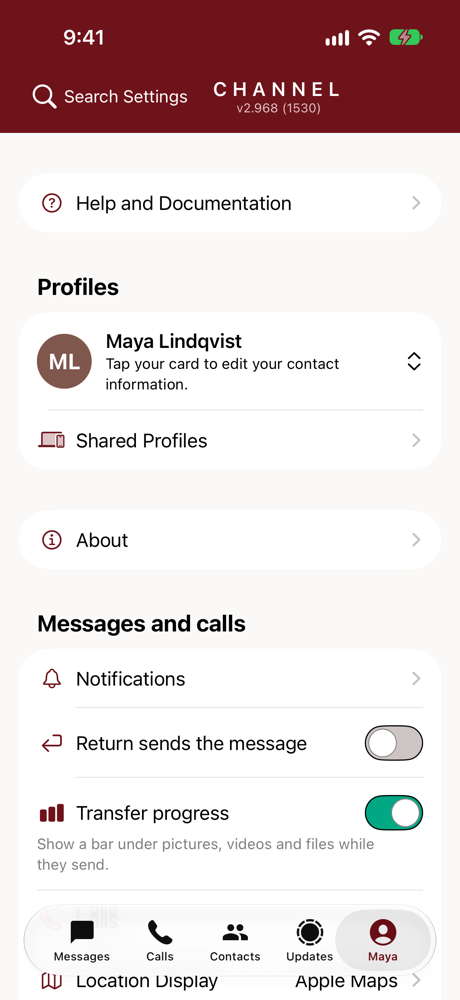
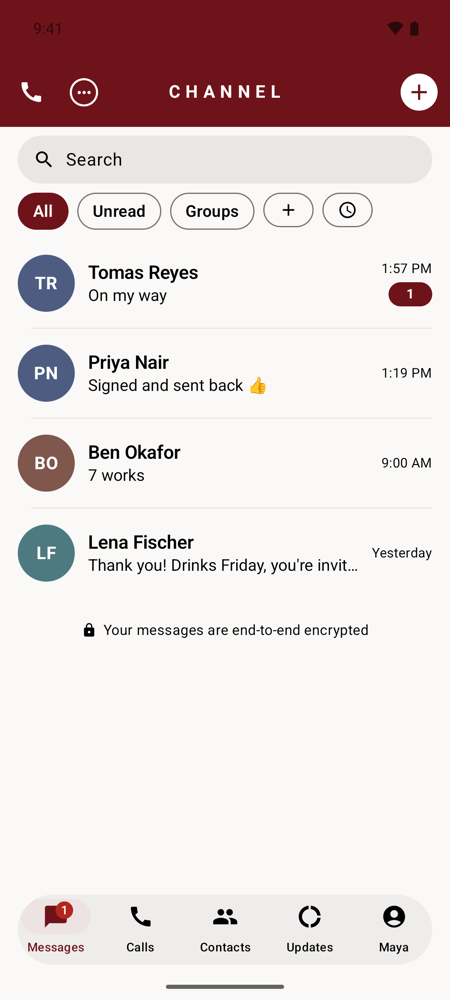
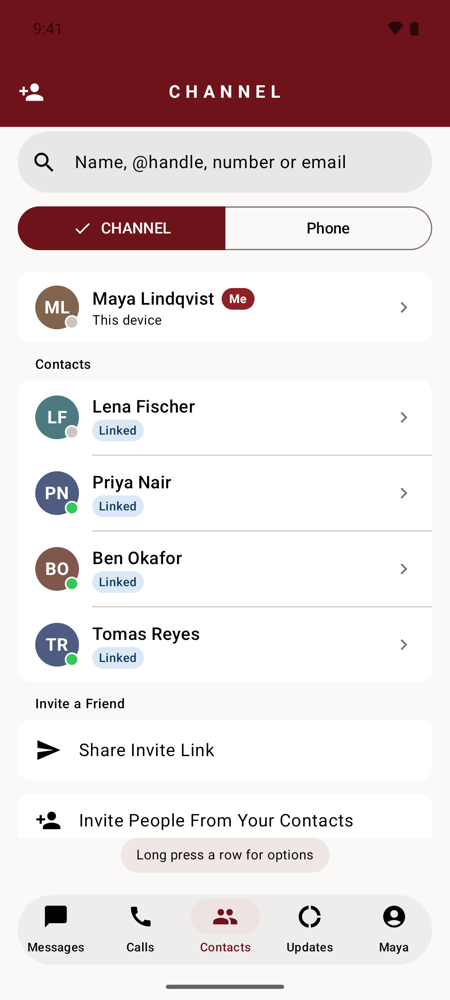
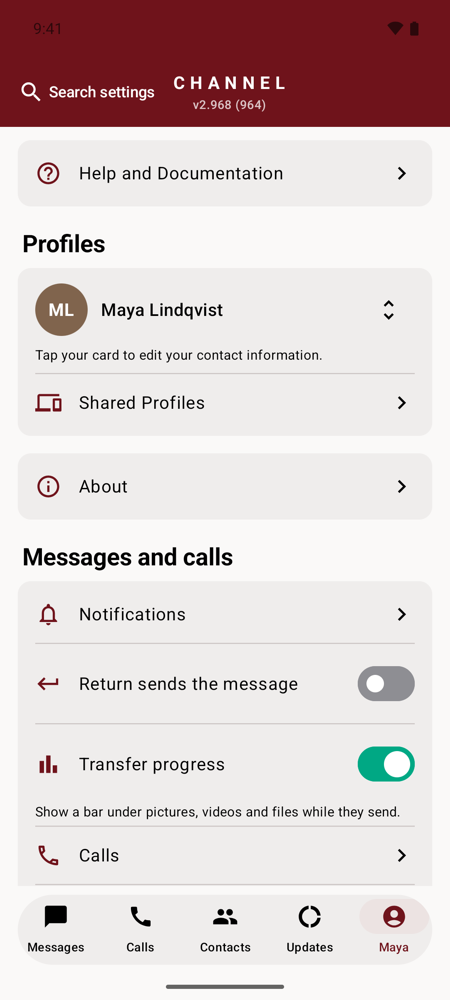
Channel looks and works like the messenger you already use — the same conversation list, the same chat screen, the same gestures. The privacy is in the plumbing, not in the controls, and it is deliberately identical on every platform so that moving between your phone and your computer teaches you nothing new.
Be told when it opens
Free preview when it's ready
Leave an address and we will write once when Channel Messenger opens for its free preview, and after that only when there is a new version to download. That is the whole reason the list exists.
We store your address and the date you sent it. Nothing else — no name, no IP address, no tracking. It is never sold, shared or rented, it is used for nothing but the two things above, and every email we send has a one-click unsubscribe. Ask us and we will delete it.
Availability
- iOS — closed testing
- Android — closed testing
- macOS — planned
- Windows — planned
Channel Messenger is not yet on the App Store or Google Play. This page will carry the links when it is.
Sources
Every claim above about a named company is taken from that company's own published terms, its own engineering blog, or a government enforcement action. Check them.
- WhatsApp, Terms of Service (revision of 28 January 2020): “You provide us the phone numbers of WhatsApp users and your other contacts in your mobile phone address book on a regular basis, and you confirm you are authorized to provide us such numbers.” The same clause appears in the 2016 revision. whatsapp.com ↩
- Federal Trade Commission, Path Social Networking App Settles FTC Charges it Deceived Consumers and Improperly Collected Personal Information from Users’ Mobile Address Books, 1 February 2013 — $800,000 penalty and twenty years of independent privacy assessments. ftc.gov ↩
- WhatsApp, Privacy Policy, on the phone numbers provided from a user’s address book. whatsapp.com/legal/privacy-policy ↩
- Meta Engineering, IPLS: Privacy-preserving storage for your WhatsApp contacts, 22 October 2024 — contact names encrypted with a key generated on the user’s device. engineering.fb.com ↩
- Data Protection Commission (Ireland), Decision in Facebook “Data Scraping” Inquiry, 28 November 2022 — €265 million fine and a reprimand. The inquiry examined Facebook Search, Facebook Messenger Contact Importer and Instagram Contact Importer; the scraped dataset covered roughly 533 million people and included names, phone numbers, locations, dates of birth and email addresses. dataprotection.ie ↩
- Office of the Director of National Intelligence, Senior Advisory Group Panel Declassified Report on Commercially Available Information (dated January 2022, released June 2023). The panel found that Intelligence Community elements construe Carpenter v. United States (2018) narrowly so as to continue purchasing information from data brokers that would otherwise require legal process. dni.gov ↩
- Federal Trade Commission, FTC Order Prohibits Data Broker X-Mode Social and Outlogic from Selling Sensitive Location Data, 9 January 2024 — the Commission's first settlement with a data broker over sensitive location information; a comparable order against InMarket Media followed on 18 January 2024. ftc.gov · InMarket order ↩
- Gen. Michael Hayden, Director of the NSA 1999–2005 and of the CIA 2006–2009, speaking at the Johns Hopkins University Foreign Affairs Symposium in 2014, in debate with David Cole. In fairness he added immediately afterwards, “But that's not what we do with this metadata” — referring to domestic collection. The point stands on its own: the man who ran both agencies was explaining that metadata alone is considered a sufficient basis for lethal action, without anybody reading a word of content. Video clip, Just Security ↩